Lesson 6
Āṇavopāya
The Way of Action
Tangible support
The Āṇavopāya techniques are employing physical and mental activities like concentration type meditation techniques, mantra and ritual, to gradually elevate the practitioner’s consciousness by focusing on an object such as breath, body or sensation.
Āṇavopāya is the most accessible method, utilizing support from the body, mind and senses.
Simply speaking it is focusing on two objects to find the center in between.
_
THE CENTERING BREATH - Audio Meditation
Four more Āṇavopāya type meditation techniques
If Āṇavopāya feels aligned for you try the above audio meditation or one of the following techniques.
Tip! Screenshot, save in your phone to remind your practice.
For our friends using translation services, scroll to the bottom for the text in plain text.

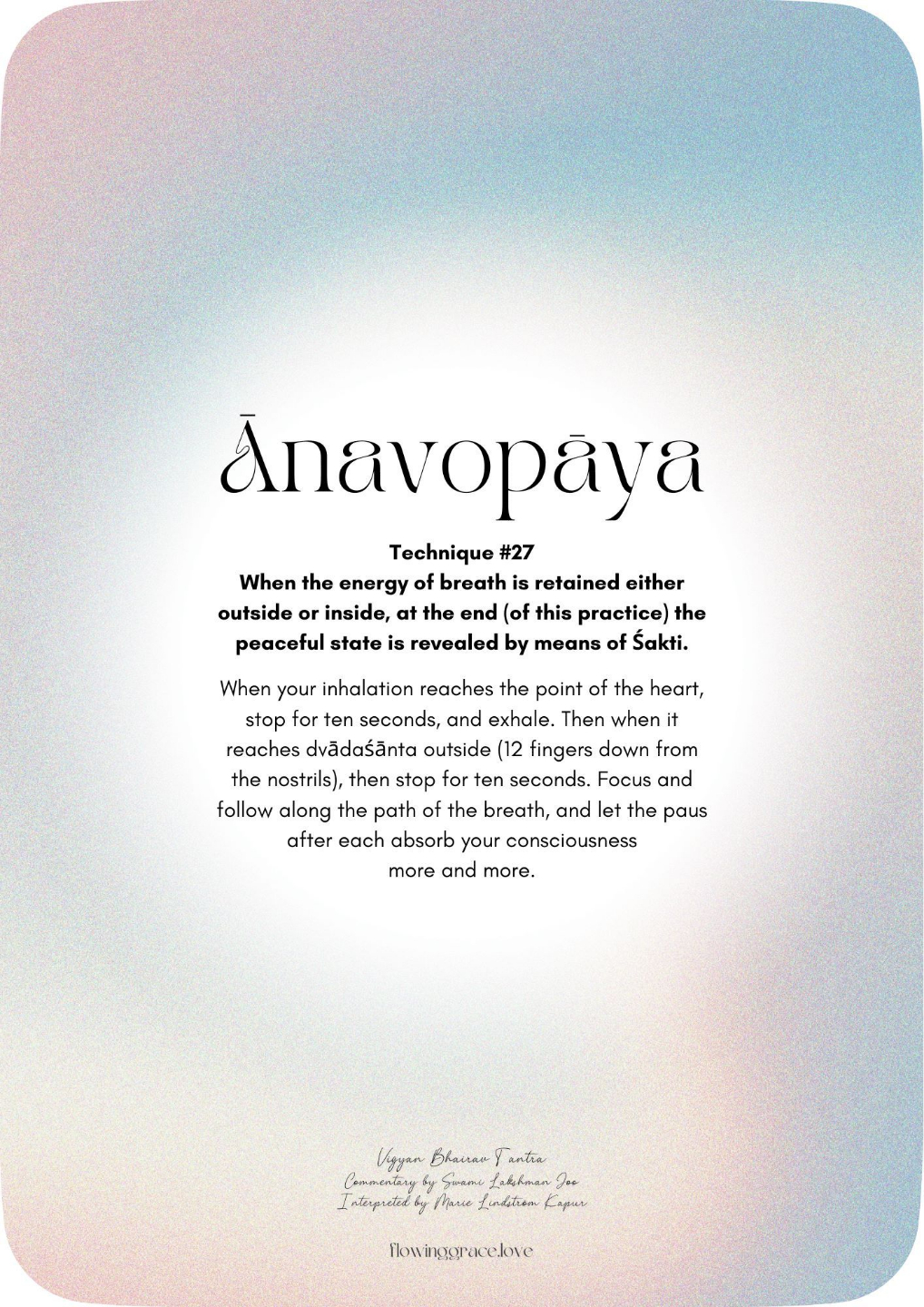
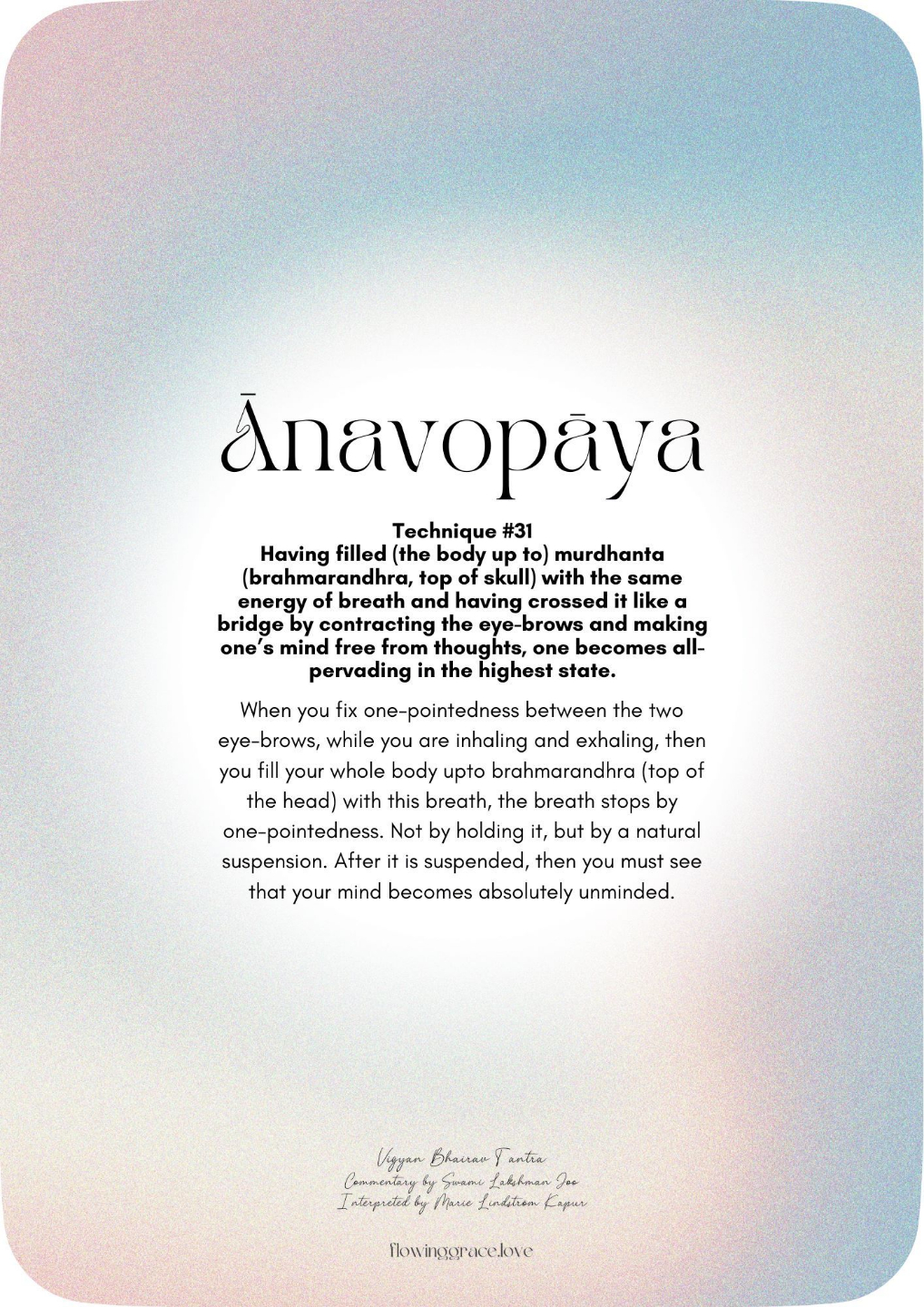
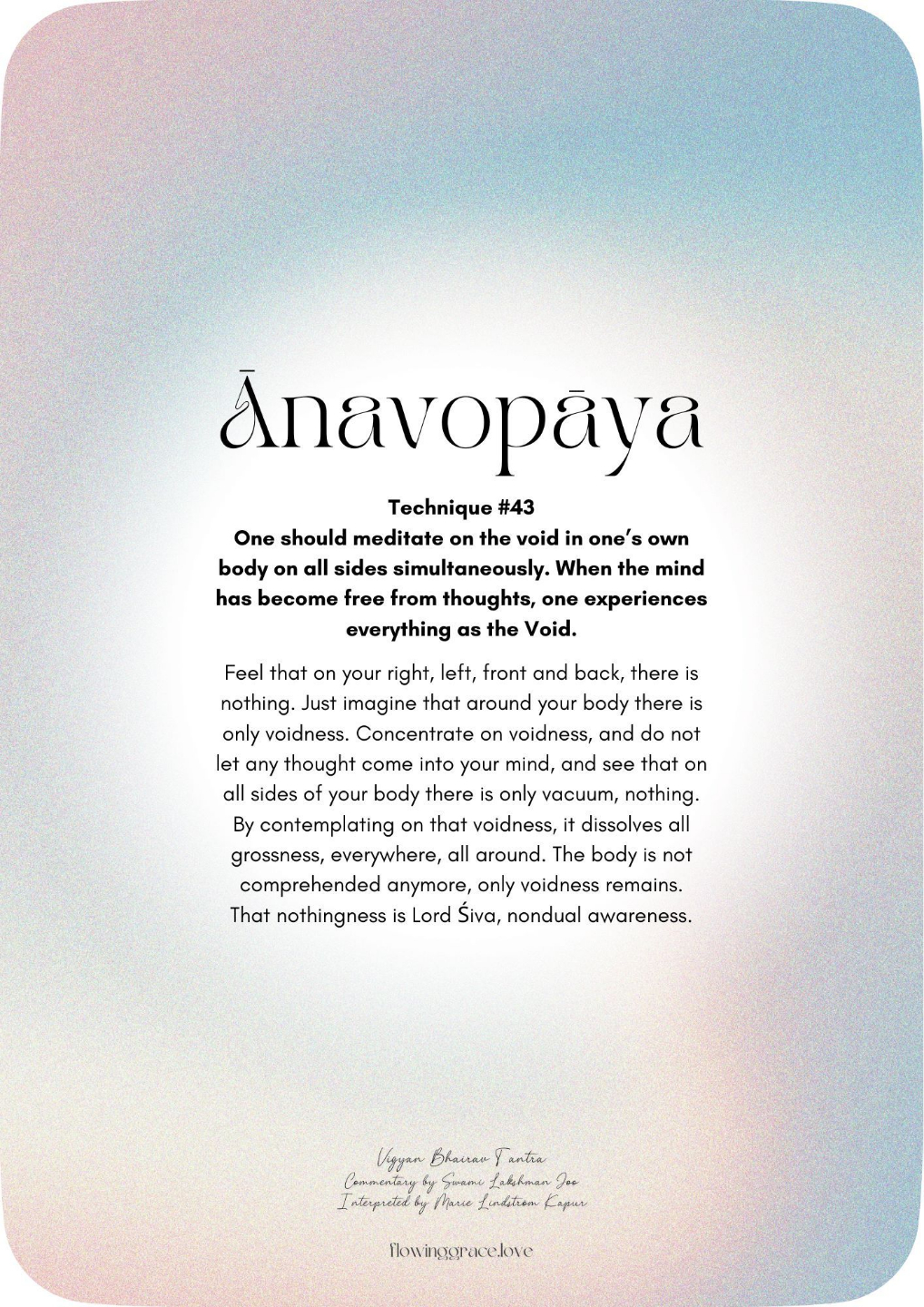
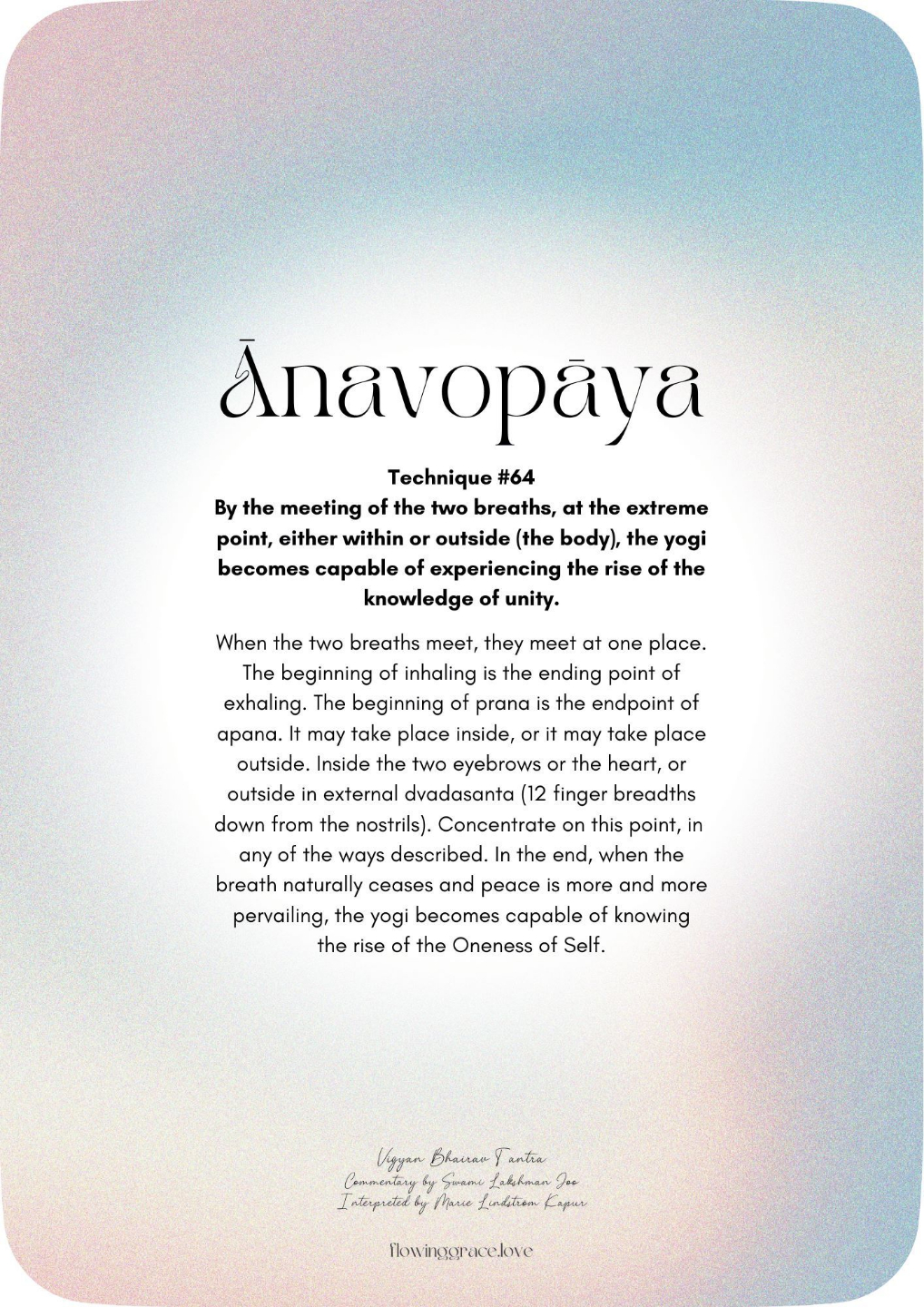
Plain text descriptions of the above meditation cards.
Technique 27
When the energy of breath is retained either outside or inside, at the end (of this practice) the peaceful state is revealed by means of Śakti.
When your inhalation reaches the point of the heart, stop for ten seconds, and exhale. Then when it reaches dvādaśānta outside (12 fingers down from the nostrils), then stop for ten seconds. Focus and follow along the path of the breath, and let the paus after each absorb your consciousness more and more.
Technique 31
Having filled (the body up to) murdhanta (brahmarandhra, top of skull) with the same energy of breath and having crossed it like a bridge by contracting the eye-brows and making one’s mind free from thoughts, one becomes all-pervading in the highest state.
When you fix one-pointedness between the two eye-brows, while you are inhaling and exhaling, then you fill your whole body upto brahmarandhra (top of the head) with this breath, the breath stops by
one-pointedness. Not by holding it, but by a natural suspension. After it is suspended, then you must see that your mind becomes absolutely unminded.
Technique 43
One should meditate on the void in one’s own body on all sides simultaneously. When the mind has become free from thoughts, one experiences everything as the Void.
Feel that on your right, left, front and back, there is nothing. Just imagine that around your body there is only voidness. Concentrate on voidness, and do not let any thought come into your mind, and see that on all sides of your body there is only vacuum, nothing. By contemplating on that voidness, it dissolves all grossness, everywhere, all around. The body is not comprehended anymore, only voidness remains. That nothingness is Lord Śiva, nondual awareness.
Technique 64
By the meeting of the two breaths, at the extreme point, either within or outside (the body), the yogi becomes capable of experiencing the rise of the knowledge of unity.
When the two breaths meet, they meet at one place. The beginning of inhaling is the ending point of exhaling. The beginning of prana is the endpoint of apana. It may take place inside, or it may take place outside. Inside the two eyebrows or the heart, or outside in external dvadasanta (12 finger breadths down from the nostrils). Concentrate on this point, in any of the ways described. In the end, when the breath naturally ceases and peace is more and more pervailing, the yogi becomes capable of knowing the rise of the Oneness of Self.
🙏🏼